▶ "1 in 2 citizens will be seniors by 2050… The 'Housing + Care' market is opening" — RSQUARE releases Senior Housing Report
▶ 64% express interest in senior housing, yet supply rate remains at a mere 0.11%
▶ Senior population aged 60+ projected to reach 22.18 million (47% of total) by 2050, accompanied by a rise in high-income households earning 100 million KRW+
▶ Gaps emerge between high-end senior housing and basic care — Demand calls for diversified supply models segmented by price and service levels
While demand for senior housing is clearly established, high costs have emerged as a primary barrier to entry. Among retirees surveyed, 64% expressed a willingness to move into senior housing. However, the RSQUARE Research Center analyzed that "while high-end senior housing remains financially burdensome, there is a distinct lack of products targeting the mid-tier price segment — seniors who seek more comprehensive services than standard care can offer." To absorb the rapidly expanding senior demographic, the industry must move away from an exclusive focus on high-cost residential facilities and diversify into real estate products segmented by price and service levels.
On the 15th, RSQUARE (CEO: Lee Yong-gyun), a full-service commercial real estate firm, published the '2026 Senior Housing Report: 1 in 3 Citizens Is a Senior — Is Korea Ready?'. The report analyzes domestic senior demographics, income structures, housing supply and demand dynamics, alongside case studies of domestic and international senior housing and care services.
Senior Population to Reach 22.18 Million by 2050 — Growing Purchasing Power Collides With Price Barriers
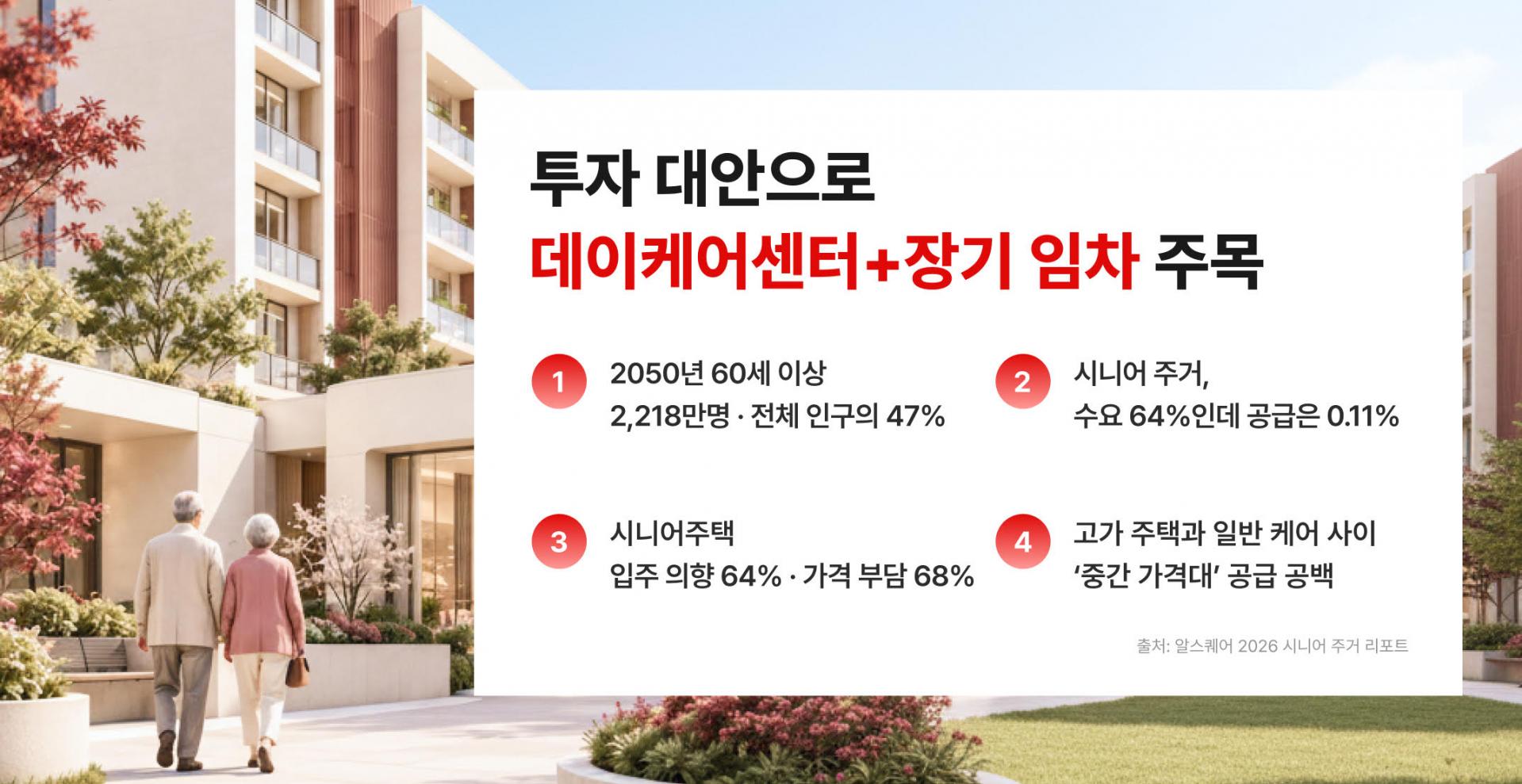
Potential demand in the senior housing market is expanding rapidly. In 2026, Korea's population aged 60 and older stands at approximately 15.17 million, accounting for 29% of the total population, and is projected to surge to approximately 22.18 million (47%) by 2050. Essentially, the senior demographic — currently 1 in 3 citizens — will grow to nearly 1 in 2 in about 25 years.
Purchasing power among seniors is also rising. The proportion of households headed by individuals aged 60+ with an annual income of 100 million KRW or more increased by 16 percentage points, rising from 21% in 2017 to 37% in 2025. This expanding demographic of financially capable seniors is widening the market foundation for senior housing and services.
However, growing purchasing power has not eliminated price resistance toward high-cost senior housing. In a survey of retirees conducted by the Land & Housing Institute, 64% of respondents expressed willingness to move into senior housing. Yet, 'price and cost burden' was cited as the biggest obstacle to moving in by 68% of respondents. When choosing a residence, 'price and cost burden' (60%) and 'linked medical and care services' (51%) were ranked as core factors.
In short, while potential demand for senior housing is strong, actual adoption hinges on whether a facility can simultaneously meet an affordable price point and the required level of care.
64% Interest vs. 0.11% Supply Rate — A 'Dual Constraint' of Price and Supply
While prospective residents face financial hurdles, supply itself remains severely constrained. Korea's senior housing supply rate stands at just 0.11%, significantly lower than the US (5.58%), the UK (4.42%), and Japan (2.12%). Compared to the US, Korea's supply level is approximately one-fiftieth.
The report notes that while Korea's senior housing market holds strong growth potential driven by rapid aging and rising care demand, factors such as land and building ownership mandates, complex permitting processes, and restricted financing structures continue to bottleneck supply expansion.
Consequently, simply increasing the supply of high-end senior housing will not suffice to absorb expanding market demand. There is a substantial 'mid-tier demand group' that finds high-end senior housing too costly yet desires more diverse, higher-quality care than standard senior services offer — yet product offerings for this segment remain scarce in Korea.
Bridging the Gap Between High-End Housing and Basic Care — Day Care Centers Take Center Stage
RSQUARE highlights Day Care Centers as a viable business model to address this unmet demand. By allowing seniors to remain in their current homes while visiting centers for health management, rehabilitation, meals, and leisure, this approach reduces the financial burden of moving into dedicated senior housing while delivering richer services than basic care.
From a real estate investment perspective, day care centers utilize standard commercial buildings, offering higher asset liquidity than dedicated senior housing facilities, and allow for long-term lease structures with professional operators. The report suggests that senior housing development must also diversify its business structures — pairing professional operators with REITs to separate property ownership from service operations, shifting from traditional development-and-hold models toward integrated service-and-operations structures.
"While interest in senior housing is high, price burden remains the single greatest constraint in actual decision-making, alongside strong demand for integrated medical and care services," said Tae-jin An, Researcher at RSQUARE. "Moving forward, the senior housing market is highly likely to transition into a lifestyle design and support industry that comprehensively delivers residential, healthcare, caregiving, and community services."






 \

▶ "1 in 2 citizens will be seniors by 2050… The 'Housing + Care' market is opening" — RSQUARE releases Senior Housing Report
▶ 64% express interest in senior housing, yet supply rate remains at a mere 0.11%
▶ Senior population aged 60+ projected to reach 22.18 million (47% of total) by 2050, accompanied by a rise in high-income households earning 100 million KRW+
▶ Gaps emerge between high-end senior housing and basic care — Demand calls for diversified supply models segmented by price and service levels
While demand for senior housing is clearly established, high costs have emerged as a primary barrier to entry. Among retirees surveyed, 64% expressed a willingness to move into senior housing. However, the RSQUARE Research Center analyzed that "while high-end senior housing remains financially burdensome, there is a distinct lack of products targeting the mid-tier price segment — seniors who seek more comprehensive services than standard care can offer." To absorb the rapidly expanding senior demographic, the industry must move away from an exclusive focus on high-cost residential facilities and diversify into real estate products segmented by price and service levels.
On the 15th, RSQUARE (CEO: Lee Yong-gyun), a full-service commercial real estate firm, published the '2026 Senior Housing Report: 1 in 3 Citizens Is a Senior — Is Korea Ready?'. The report analyzes domestic senior demographics, income structures, housing supply and demand dynamics, alongside case studies of domestic and international senior housing and care services.
Senior Population to Reach 22.18 Million by 2050 — Growing Purchasing Power Collides With Price Barriers
Potential demand in the senior housing market is expanding rapidly. In 2026, Korea's population aged 60 and older stands at approximately 15.17 million, accounting for 29% of the total population, and is projected to surge to approximately 22.18 million (47%) by 2050. Essentially, the senior demographic — currently 1 in 3 citizens — will grow to nearly 1 in 2 in about 25 years.
Purchasing power among seniors is also rising. The proportion of households headed by individuals aged 60+ with an annual income of 100 million KRW or more increased by 16 percentage points, rising from 21% in 2017 to 37% in 2025. This expanding demographic of financially capable seniors is widening the market foundation for senior housing and services.
However, growing purchasing power has not eliminated price resistance toward high-cost senior housing. In a survey of retirees conducted by the Land & Housing Institute, 64% of respondents expressed willingness to move into senior housing. Yet, 'price and cost burden' was cited as the biggest obstacle to moving in by 68% of respondents. When choosing a residence, 'price and cost burden' (60%) and 'linked medical and care services' (51%) were ranked as core factors.
In short, while potential demand for senior housing is strong, actual adoption hinges on whether a facility can simultaneously meet an affordable price point and the required level of care.
64% Interest vs. 0.11% Supply Rate — A 'Dual Constraint' of Price and Supply
While prospective residents face financial hurdles, supply itself remains severely constrained. Korea's senior housing supply rate stands at just 0.11%, significantly lower than the US (5.58%), the UK (4.42%), and Japan (2.12%). Compared to the US, Korea's supply level is approximately one-fiftieth.
The report notes that while Korea's senior housing market holds strong growth potential driven by rapid aging and rising care demand, factors such as land and building ownership mandates, complex permitting processes, and restricted financing structures continue to bottleneck supply expansion.
Consequently, simply increasing the supply of high-end senior housing will not suffice to absorb expanding market demand. There is a substantial 'mid-tier demand group' that finds high-end senior housing too costly yet desires more diverse, higher-quality care than standard senior services offer — yet product offerings for this segment remain scarce in Korea.
Bridging the Gap Between High-End Housing and Basic Care — Day Care Centers Take Center Stage
RSQUARE highlights Day Care Centers as a viable business model to address this unmet demand. By allowing seniors to remain in their current homes while visiting centers for health management, rehabilitation, meals, and leisure, this approach reduces the financial burden of moving into dedicated senior housing while delivering richer services than basic care.
From a real estate investment perspective, day care centers utilize standard commercial buildings, offering higher asset liquidity than dedicated senior housing facilities, and allow for long-term lease structures with professional operators. The report suggests that senior housing development must also diversify its business structures — pairing professional operators with REITs to separate property ownership from service operations, shifting from traditional development-and-hold models toward integrated service-and-operations structures.
"While interest in senior housing is high, price burden remains the single greatest constraint in actual decision-making, alongside strong demand for integrated medical and care services," said Tae-jin An, Researcher at RSQUARE. "Moving forward, the senior housing market is highly likely to transition into a lifestyle design and support industry that comprehensively delivers residential, healthcare, caregiving, and community services."