▲ Research Center releases KIC ROSI Report: "First upward turn after a 25% plunge from peak"
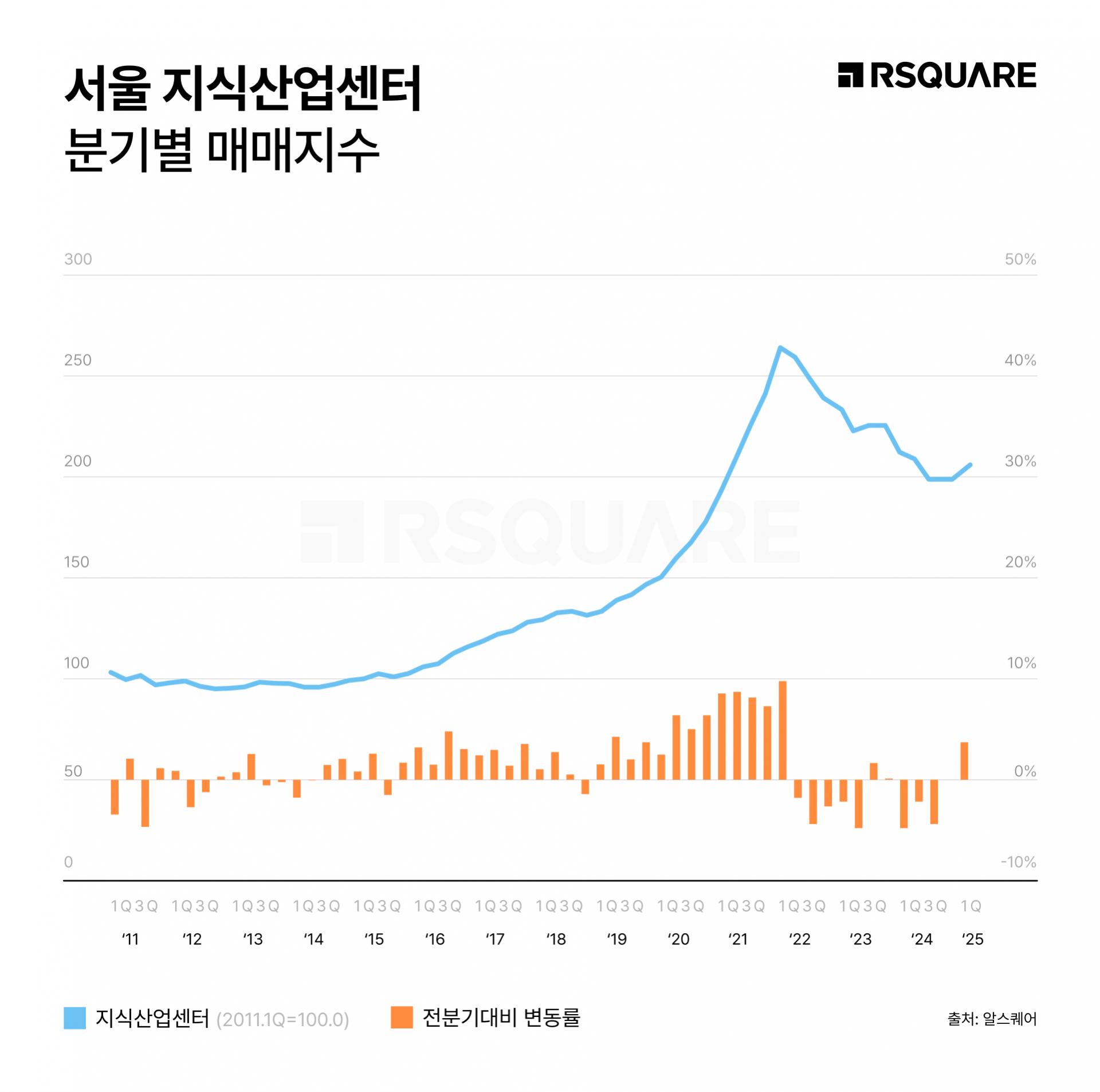
▲ RA: Q2 2025 Sales Index hits 201.1 points, up 3.9% from the previous quarter
▲ "Recovery will be highly limited without a surge in actual end-user demand"
The Seoul Knowledge Industry Center (KIC) market has emerged from its prolonged downward spiral, successfully rebounding in the second quarter of this year. The price decline that had persisted since the second half of 2022 has halted, shifting toward a modest upward trend.
Commercial real estate comprehensive service firm RSQUARE (CEO: Lee Yong-gyun) released the 'Q2 2025 Knowledge Industry Center Sales Index (ROSI)' report on the 12th.
According to RA (RSQUARE Analytics), the index for this quarter stood at 201.1 points, more than double the base point of Q1 2011 (100 points).
This represents a 3.9% increase from the previous quarter, although it remains 4.1% lower than the same period last year. From 2011 to 2019, the KIC market maintained stable annual price growth of around 3%.
However, from 2020 through Q2 2022—when KICs gained popularity as "alternative investment assets"—prices skyrocketed by over 20% annually. At the time, low entry barriers for small-scale investors and more lenient loan regulations compared to residential properties acted as major catalysts.
The market took a sharp turn in the second half of 2022. By Q1 2025, the index had plummeted by approximately 25% from its peak, undergoing a long period of adjustment. With transaction volumes drying up, the entire market had entered a deep recession.
This quarter’s rebound is attributed to interest rate cuts and favorable policy changes. Analysis suggests that as the debt burden—which had suppressed buyer sentiment—eased, there has been a renewed movement to reconsider acquisitions.
"While it appears that a rebound has occurred due to shifts in interest rates and the institutional environment, it is premature to predict if this upward trend will be sustainable," said the RSQUARE Research Center. They added, "Unlike offices, KICs are not supported by stable rental income; therefore, the market can only be considered truly recovered when actual end-user demand (leasing demand) increases."
KICs are typically located in peripheral industrial hubs like Guro, Gasan, Seongsu, and Magok rather than central business districts. A key characteristic is the high participation of individual investors, as units are often sold as strata-titled properties.
This structure, which facilitates small-sum investments, caused a surge in demand when residential regulations were tightened. However, due to inherently weaker leasing demand, while prices can rise easily, they also tend to fall rapidly during downturns. The decline over the past two years coincided with a swift exit by investors, shrinking the overall market.
Transaction volumes are also showing signs of life. Since 2015, the annual transaction value of the KIC market had stayed above 1 trillion KRW, peaking at over 2 trillion KRW in 2021. However, transactions plummeted starting in 2022 as rate hikes began in earnest, only showing signs of recovery in Q2 of this year.
Regarding the future, the RSQUARE Research Center emphasized, "While a short-term price rebound is possible, a sustained recovery must be accompanied by actual improvements in the leasing market and end-user demand."
The RSQUARE Knowledge Industry Center Sales Index (ROSI) is calculated using a methodology similar to the U.S. Case-Shiller index, tracking price trends by comparing the historical transaction records of the same buildings. The base point for the KIC index is Q1 2011 (100 points).






 \

▲ Research Center releases KIC ROSI Report: "First upward turn after a 25% plunge from peak"
▲ RA: Q2 2025 Sales Index hits 201.1 points, up 3.9% from the previous quarter
▲ "Recovery will be highly limited without a surge in actual end-user demand"
The Seoul Knowledge Industry Center (KIC) market has emerged from its prolonged downward spiral, successfully rebounding in the second quarter of this year. The price decline that had persisted since the second half of 2022 has halted, shifting toward a modest upward trend.
Commercial real estate comprehensive service firm RSQUARE (CEO: Lee Yong-gyun) released the 'Q2 2025 Knowledge Industry Center Sales Index (ROSI)' report on the 12th.
According to RA (RSQUARE Analytics), the index for this quarter stood at 201.1 points, more than double the base point of Q1 2011 (100 points).
This represents a 3.9% increase from the previous quarter, although it remains 4.1% lower than the same period last year. From 2011 to 2019, the KIC market maintained stable annual price growth of around 3%.
However, from 2020 through Q2 2022—when KICs gained popularity as "alternative investment assets"—prices skyrocketed by over 20% annually. At the time, low entry barriers for small-scale investors and more lenient loan regulations compared to residential properties acted as major catalysts.
The market took a sharp turn in the second half of 2022. By Q1 2025, the index had plummeted by approximately 25% from its peak, undergoing a long period of adjustment. With transaction volumes drying up, the entire market had entered a deep recession.
This quarter’s rebound is attributed to interest rate cuts and favorable policy changes. Analysis suggests that as the debt burden—which had suppressed buyer sentiment—eased, there has been a renewed movement to reconsider acquisitions.
"While it appears that a rebound has occurred due to shifts in interest rates and the institutional environment, it is premature to predict if this upward trend will be sustainable," said the RSQUARE Research Center. They added, "Unlike offices, KICs are not supported by stable rental income; therefore, the market can only be considered truly recovered when actual end-user demand (leasing demand) increases."
KICs are typically located in peripheral industrial hubs like Guro, Gasan, Seongsu, and Magok rather than central business districts. A key characteristic is the high participation of individual investors, as units are often sold as strata-titled properties.
This structure, which facilitates small-sum investments, caused a surge in demand when residential regulations were tightened. However, due to inherently weaker leasing demand, while prices can rise easily, they also tend to fall rapidly during downturns. The decline over the past two years coincided with a swift exit by investors, shrinking the overall market.
Transaction volumes are also showing signs of life. Since 2015, the annual transaction value of the KIC market had stayed above 1 trillion KRW, peaking at over 2 trillion KRW in 2021. However, transactions plummeted starting in 2022 as rate hikes began in earnest, only showing signs of recovery in Q2 of this year.
Regarding the future, the RSQUARE Research Center emphasized, "While a short-term price rebound is possible, a sustained recovery must be accompanied by actual improvements in the leasing market and end-user demand."
The RSQUARE Knowledge Industry Center Sales Index (ROSI) is calculated using a methodology similar to the U.S. Case-Shiller index, tracking price trends by comparing the historical transaction records of the same buildings. The base point for the KIC index is Q1 2011 (100 points).